Showing posts with label Class 11 & Class 12 Organic Chemistry. Show all posts

Monday, 3 December 2018

Types of Hybridization and Concept of Hybridization


Types of hybridization in carbon compounds
We shall now try to understand the different hybridizations of carbon in organic compounds. Carbon in organic compounds exhibits three types of hybridization. Namely, sp3, sp2 and sp.

Effect of hybridization on organic compounds:
• Bond length
• Bond energy

Concept of Hybridization

sp3 hybridization
Let us try to understand the sp3 hybridization with the help of structure of methane (CH4). The electronic configuration of a carbon atom in its lowest energy stateº, called the ground state is represented as (I) where there are only two unpaired electrons. But for the formation of a molecule like CH4, 4 unpaired electrons are required. Thus, the carbon atom gets excited to a higher energy state (one electron from 2s is excited to 2p) called the excited state (II). (Figure: 6.1)


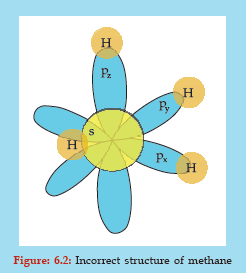
The carbon atom now has the required four electrons and must combine with four hydrogen atoms to form a methane molecule. But it does not! Because, if this happens, then, as we know, the s orbital is spherical and the p orbital is dumb-bell shaped, the methane molecule must have the structure as shown below (Figure: 6.2) where three C-H bonds are longer than one C-H bond and the some angles between C-H bonds are 90° (due to 90° relative orientation of px, py and pz).
But this is not how the real molecule is! In fact, methane has a tetrahedral structure with all the C-H bonds are of equal length and all the bond angles 109°28′ as shown by crystallographic, X-ray and other studies. This can be accounted by the concept of hybridization. In hybridization, equal number of hybrid orbitals result from reorganisation of atomic orbitals. Here, the four atomic orbitals, one s orbital (2s) and three p orbitals (2px , 2py , and 2pz ) undergo hybridization and give rise to an equal
number of (i.e., four sp3) hybrid orbitals.
These are called sp3 hybrid orbitals as they have one part the character of an s orbital and three parts the character of a p orbital. They arrange themselves, with the maximum separation from each other, in a tetrahedral manner and 109°28' as the angle of orientation with respect to each other as shown in (Figure 6.3).


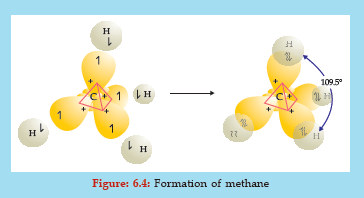
These four sp3 hybrid orbitals now overlap with the s orbitals of four hydrogen atoms (one each) to give a tetrahedral structure for methane having all equivalent C-H sigma bonds and all bond angles as 109°28' or 109.5° (Fig.6.4).


Example: Ammonia molecule


sp2 hybridization
Let us try to understand the sp2 hybridization with the help of structure of ethene (C2H4). In ethene, the carbon-carbon double bond has one s (sigma) bond and one π (pi) bond. Each carbon is further attached to two hydrogen atoms by s bonds as shown below
As discussed in the earlier case, the excited states of each carbon can be shown as in Figure: 6.5:

As you already know that the π bond is always formed by the overlap of unhybridised p orbitals (as the [p bond is a two way overlap, one above and one below the inter-nuclear axis and thus not possible with the hybrid orbitals where electron density in one lobe is very small and cannot take part in the bonding via sufficient overlap). Let us assume Z to be the internuclear axis. Thus, one of the 2py or 2px orbitals of one carbon atom overlaps sideways with 2py or 2px orbitals of the other carbon atom (here, let us say 2px) respectively to form the p bond as shown in Figure: 6.6.


Now, in the valence shell, each carbon atom is left with one s orbital (2s) and two p orbitals (2pz and 2py), which undergo hybridization and give rise to three sp2 hybrid orbitals.


These are called sp2 hybrid orbitals to indicate that they have one part the character of s orbital and two parts the character of a p orbital. These three sp2 orbitals are directed towards the corners of a regular triangle with angles of 120° between them. The unhybridised p (2px) orbital is perpendicular to the plane of the triangle formed by the sp2 hybrid orbitals. This gives the structure of ethene as shown in Figure: 6.7.
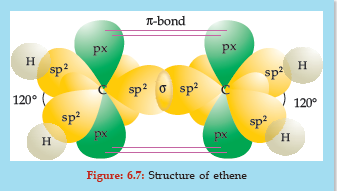


There are a total of five s bonds in the ethene molecule. One carbon-carbon s bond formed via the overlap of one sp2 hybrid orbital of each carbon. Four carbon-hydrogen s bonds formed by the remaining two-sp2 hybrid orbitals on each carbon overlapping with two hydrogen atoms (one each), i.e. two σ bonds on each carbon atoms. The bond angle between each bond is 120°. All the six atoms (two carbon and four hydrogen) lie in the same plane and the π orbitals are perpendicular to this plane. Ethene has thus a planar structure.

sp hybridization
Let us try to understand the sp hybridization with the help of structure of ethyne (C2H2). In ethyne, the carbon-carbon triple bond has one σ (sigma) bond and two π (pi) bonds as shown below

As earlier, the excited states of each carbon atom can be shown as follows:


Let us assume Z to be the internuclear axis, then the 2py and 2px of one-carbon overlap sideways with a 2py and 2px of the other carbon atom respectively to form two π bonds. Each carbon atom is left with one s orbital (2s) and one p orbital (2pz), which undergo hybridization and give rise to two sp hybrid orbitals.


These hybrid orbitals are called sp orbitals to indicate that they have one part the character of the s orbital and one part the character of the p orbital. These two sp hybrid orbitals are directed in a linear fashion with angles of 180° between them (Figure: 6.9).
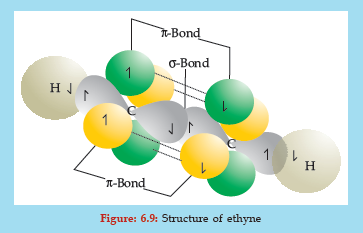


One sp hybrid orbital of each carbon overlaps to form a carbon-carbon s bond. The remaining sp hybrid orbital on each carbon overlaps with one hydrogen atom each to give two s bonds. Thus a total of three s bonds are found in the ethyne molecule. The bond angle between each bond is 180°. Acetylene is a linear molecule as all the four atoms (two carbon and two hydrogen) lie along the same straight line. Also, it has a cylindrical symmetry about the inter-nuclear axis due to the p electron cloud present in a cylindrical manner.




Origin of Organic Chemistry as a Separate Branch of Chemistry


Early concepts of organic chemistry

Chemical compounds are divided into two main classes, inorganic and organic. Earlier, all substances were classified on the basis of the sources from which they were derived. Hence, all compounds that were of mineral origin were known as inorganic compounds (e.g. table salt, rock salt,  marble, etc.) and all compounds of vegetable and animal origin were known as organic compounds (e.g. alcohol,  citric acid, oxalic acid, esters, etc.). Prior to 1828, all organic compounds had been obtained from organisms or their remains. The belief then was that the synthesis of organic compounds from inorganic compounds in the laboratory was impossible. All efforts had failed, and scientists became con¬vinced that some ‘vital force’ that living organisms had, was necessary to make an organic compound. The name 'organic', thus, originated with early chemists, who believed that organic compounds could be formed only through the action of a vital force found in living organisms. So, no effort was made to produce organic compounds in the laboratory for many decades. This was known as vital force theory.

Modern concepts of organic chemistry

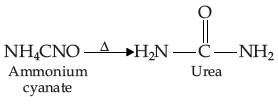
The essential distinction between organic and inorganic substances was revolutionized by Friedrich Wohler’s accidental synthesis of urea from inorganic substances in 1828. Never before had an organic compound been synthesized from inorganic substance!  

Friedrich Wöhler
Wöhler with his co-worker Justus Liebig
published an investigation related to ‘oil of
bitter almonds’. Through their experiments they
proved that a group of carbon, hydrogen and
oxygen atoms can behave like an element, take
the place of an element, and can be exchanged
for elements in chemical compounds. This lead
to the foundation of the doctrine of compound
radicals.


In the years that followed, many other different organic compounds were synthesised by different scientists in laboratories. This gave the basis for rejection of the vital force theory.

It had become evident, however, that most of the organic compounds formed by living cells contained carbon. So, the emphasis was shifted from origin to composition. Organic chemistry, thus, is now known as the branch of chemistry dealing with the study of carbon compounds.

Organic chemistry is a discipline of chemistry that deals primarily with properties, composition, synthesis of carbon compounds and their derivatives.
Organic chemistry is studied as a separate discipline because of the following reasons:
1. Carbon being a versatile element can form a large number of compounds.
2. Carbon has a unique character, which includes tetra-covalency, catenation, strong C-C bonding and the tendency to form multiple bonding (i.e. single, double, and triple bonds through covalent bond¬ing with hydrogen and other atoms).
3. Thus a large number of organic compounds are known that are classified into different families. Each family consists of compounds that have a chemically active centre called the functional group.
4. These compounds have unique chemical and physical properties. The bonding and structural features of a compound are manifested in its physical properties (melting point, boiling point, solubility, etc.) which in turn depends on the nature of atoms constituting its structural units and nature of forces holding its units together. In covalent compounds, intermolecular forces hold these molecules together. The chemical properties, on the other hand, are influenced by electronic displacements in the molecule.

Importance of organic chemistry

Organic chemistry is related to our daily life activities. We are all made of mainly organic compounds! The food we eat (carbohydrates, proteins, fats, etc.), the clothes we wear (cotton, silk, wool, nylon, rayon, dacron, etc.), our shelter (wood, paints, varnishes, etc.), the fuels we consume (natural gas, petroleum products, coal, etc.), medicines and drugs (penicillin G, streptomycin, etc.), insecticides and pesticides, biomolecules (hormones, steroids, vitamins and enzymes, etc.), antiseptics and anaesthetics, pigments and dyes, paper and ink, photographic films and developers, perfumes and flavours, plastics, rubber, resins, propellants, explosives, soaps, detergents, refrigerants, etc. are all made up of organic compounds. 
            Can you imagine your life without carbon compounds i.e. organic compounds? Do you know why carbon forms such a large number of compounds? Can you guess why diamond and graphite are so different, though they are both made up of carbon? The solution to all these and many more questions lies in Organic Chemistry, which is the study of these organic compounds.
           In this unit, we shall study some basic concepts of carbon compounds like their structure and bonding, functional groups, classifications, nomenclature, structural and stereoisomerism, fission (or cleavage) of bonds, types of reagents and types of organic reactions, aromaticity, acidity and basicity. You must try to understand all these concepts as they are the basis for understanding all the other topics in organic chemistry.


Structure of Organic Compounds

The properties of organic compounds can be best explained with the help of structure of these compounds. So it becomes very essential for us to know the structure of organic compounds which can in turn be explained with the help of the concept of hybridization. You have already studied hybridization in the chemical bonding unit.
         Here we shall study the three different types of hybridizations exhibited by carbon in different organic compounds, viz. sp3, sp2 and sp. You may be surprised to know that different carbon atoms may be present in different hybridizations in the same organic compound. We shall try to understand the different hybridizations of carbon with the help of some simple examples and then extend the concept in order to find the hybridization of any carbon in any given organic compound.